
Two thirds of the Australian businesses not using AI say the reason is trust. The National AI Centre's tracker for December to February found 43 per cent of small and medium businesses using AI in some form, and among those not using it, around 65 per cent cited either distrust of AI decision-making or a strong preference to keep a person in control of their processes. That is not a cost problem or a skills problem. It is a "what exactly am I handing over" problem.
I think a lot of that distrust comes from one confusion. The word AI is being used for three quite different things, and they hand over very different amounts of control. A thread on the ChatGPT forum this month asked, in plain terms, what people are actually using scheduled tasks for. Nearly 160 people weighed in. The feature is sitting in front of everyone, and most of us are not sure what it is for or how it differs from the chat box we already use.
So here is one enquiry, handled three ways.
The enquiry
Say you run a physio clinic. A new patient sends a web form at 8.30 on a Tuesday night. They mention knee pain after a fun run, they ask whether you take a particular health fund and they want to know if there is anything this week.
1. A chat
A chat answers when you ask. You open the tool, paste the enquiry and ask it to draft a reply in your usual tone using your clinic's FAQ. It writes a draft. You read it, change the bit about the health fund because the tool guessed and send it.
What it needs: the enquiry and whatever reference material you give it in that moment.
What it produces: one draft, once, because you asked.
Who is in control: you, completely. Nothing happens unless you start it and nothing leaves unless you send it.
This is where most owners start and it is a perfectly good place to stay for a lot of work. The tool is a fast, forgetful assistant. Every conversation starts from nothing unless you bring the context with you.2. A scheduled task
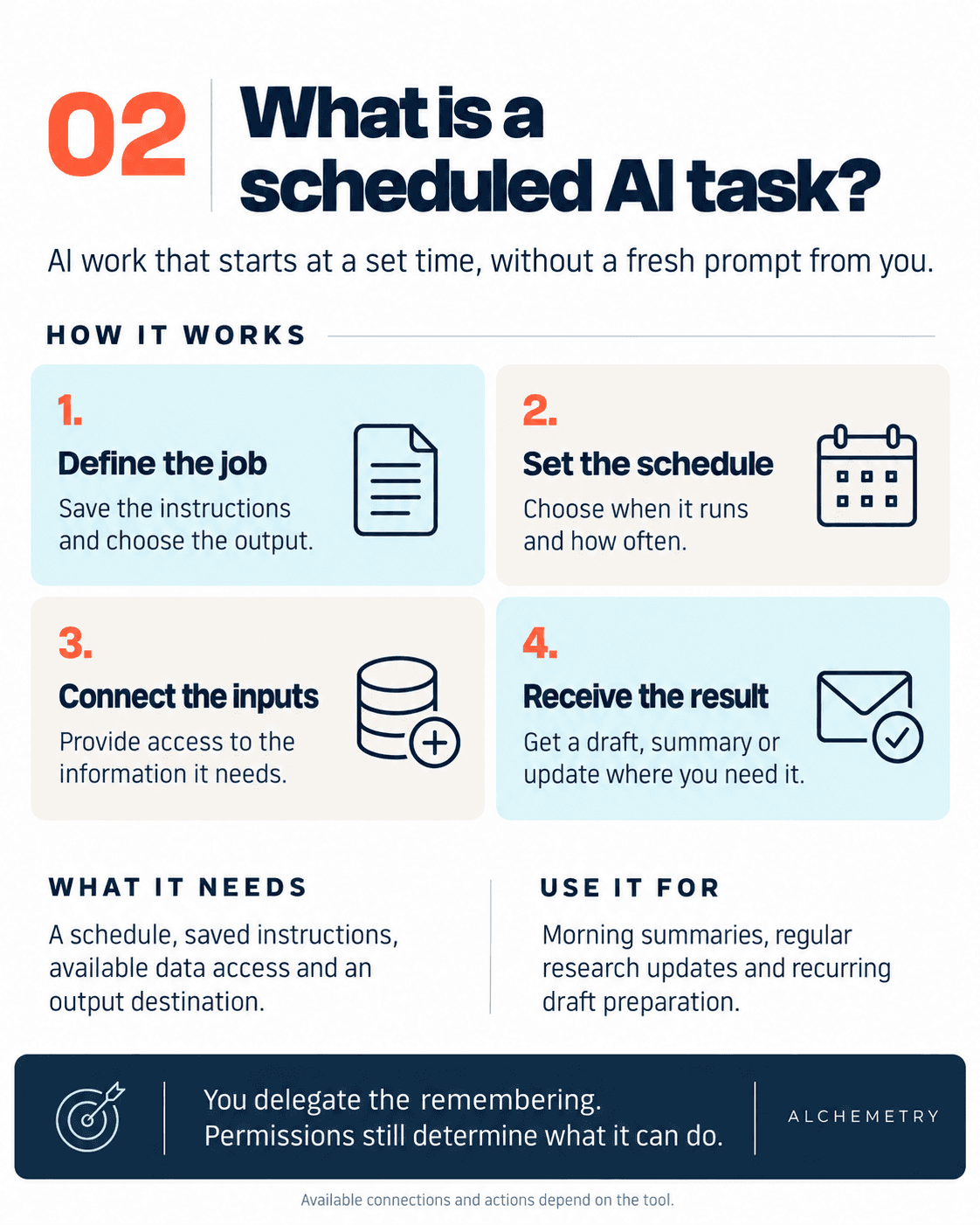
A scheduled task is the same prompt on a timer. Every morning at 7, the tool reads the enquiries that arrived overnight and writes a draft reply for each one, in the same tone, using the same FAQ and puts the drafts somewhere you will see them.
What it needs: everything the chat needed, written down once, plus a place to read from and a place to put the result.
What it produces: a pile of drafts waiting for you at 7.05, whether or not you remembered to ask.
Who is in control: still you, at the sending step. The tool never talks to the patient. But you have handed over the remembering.
This is the step people skip. It is not exciting and it is not clever. It is the same thing you did yesterday, done without you starting it. If the job is repetitive and the inputs arrive in the same place each time, this is usually all you need.
3. An agent
An agent has tools and permissions and decides its own steps. Give it the same enquiry and it might check your calendar for a Thursday slot, look up whether you accept that health fund in your practice software, draft the reply, and, if you have allowed it, send the reply and hold the slot.
What it needs: access to those systems, rules about what it may and may not do and a clear point where it stops and asks you.
What it produces: an outcome rather than a draft. The patient has an answer and a tentative booking before you have seen the enquiry.
Who is in control: whoever wrote the rules. This is the one that needs an owner and a limit, because it acts.
The people building these things for a living describe the sensible version in unglamorous terms: small, bounded workflows with clear inputs, clear permissions, one measure of success and a named person responsible. One practitioner put the small business version as one trigger, one draft or summary, one owner approval point, one metric. That is a long way from the demo videos, and it is the version I would trust.
When a plain automation is enough
Here is the test I use. If the job is the same every time and the inputs arrive in the same place, you do not need judgement in the loop. A fixed automation, no AI at all, will do it: form submitted, contact created, confirmation sent. If the job needs reading and rewording but the decision stays with you, a chat or a scheduled task covers it. An agent only earns its place when the value is in the steps between reading and deciding, and when you are comfortable writing down exactly where it must stop.
Most of the trust gap in that survey closes once you can name which of the three you are looking at. A chat hands over nothing. A task hands over the remembering. An agent hands over the doing, inside a fence you draw. Pick the smallest one that does the job.


Erin Tucker

